Scientific benchmarks
This page is the complete benchmark catalogue. Each card opens a runnable benchmark report containing its physical state, model choices, provenance, quantitative diagnostics, and downloadable Python source. Running that source calculates from physical inputs, including MD where shown; no bundled Otter NPZ is required. Documentation builds use recorded figures and terminal output and do not launch expensive calculations.
For the 0.4.1 recalculation and its numerical limits, see Otter 0.4.1 numerical validation.
The categories below are only a reading aid. Every benchmark appears exactly
once, and the left navigation links directly to the individual reports rather
than passing through separate detailed and gallery index levels.
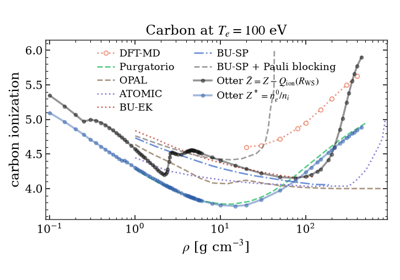
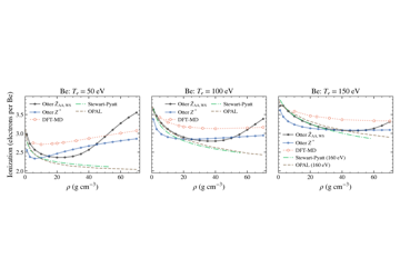
Electronic structure and ionization

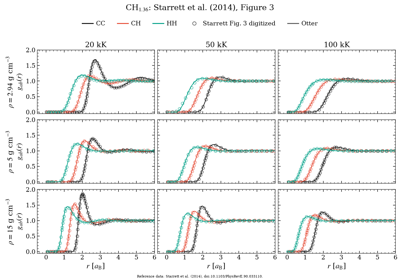
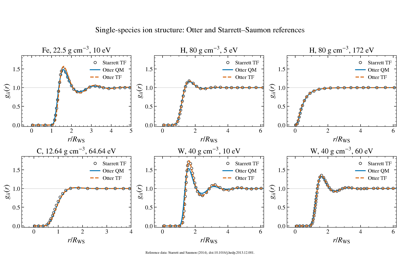
Equilibrium ion structure
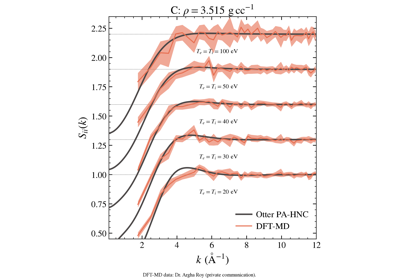
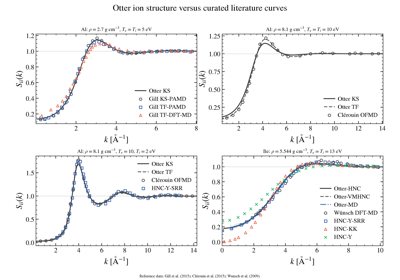
These reports compare \(g_{ab}(r)\) or \(S_{ab}(k)\) at \(T_e=T_i\) with published or attributed reference data.
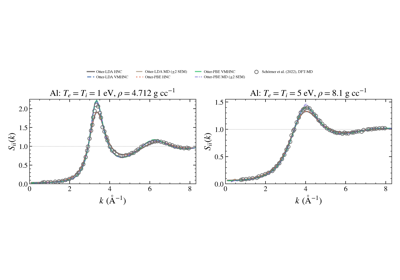
Equilibrium aluminium structure factors: Schörner et al. (2022)
Two-temperature and method validation
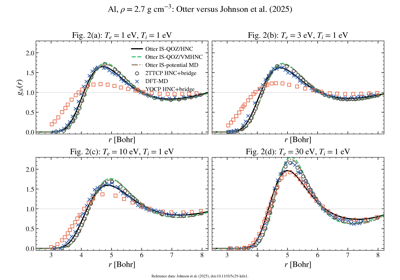
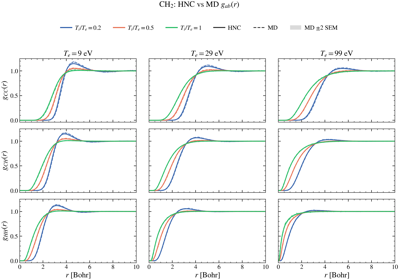
These reports test explicitly labelled \(T_e\ne T_i\) states or compare different ionic-structure treatments while holding the electronic pair potential fixed.
Cross-observable literature library
Validation and data governance
The free-channel completion controls compare the optional continuum correction with an analytic free spectrum and fresh full/external electronic states.
The validation policy defines acceptance metrics, reference-data provenance, and public-release rules.