Free-channel completion: numerical controls
These controls test the optional free-channel correction described in Free-channel continuum completion. They compare density implementations at fixed model settings. They do not validate a smaller propagation radius or replace an external physical benchmark.
Analytic free spectrum
For a zero potential, the exact spectral density, including spin and before occupation, is \(k/\pi^2\), with \(k=\sqrt{2E}\) [Starrett and Saumon, 2014, National Institute of Standards and Technology, n.d.]. The controls use energies 0.001, 0.02, 0.2 and 2 Ha and angular cutoffs 2, 8 and 32. A 2400-point square-root grid extends to 30 Bohr; residuals are measured from 1 Bohr outward. These explicit model grids and cutoffs deliberately expose angular truncation and do not alter the AA defaults.
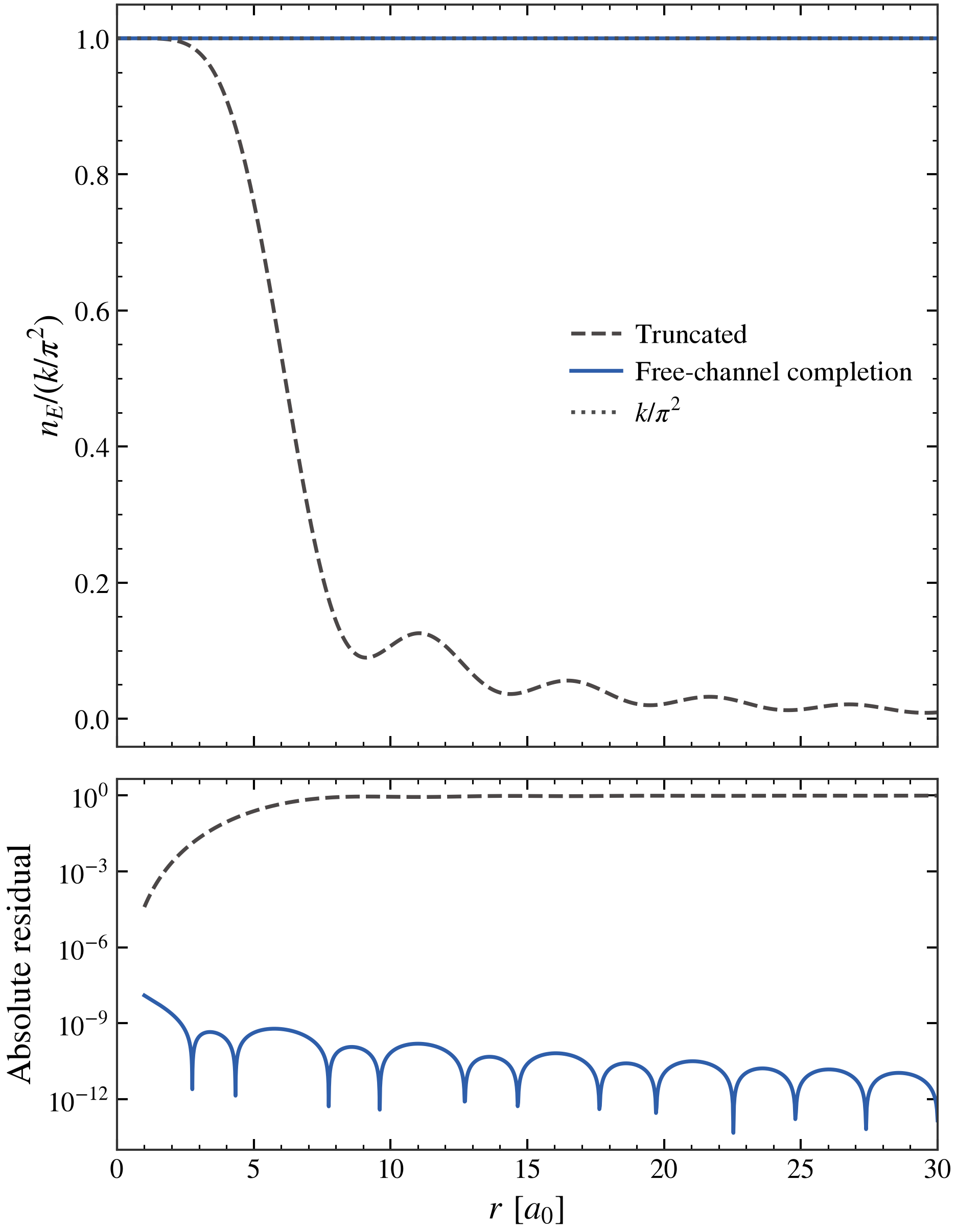
Zero potential at 0.2 Ha with \(L=2\). The dotted line gives the exact
free spectrum. Residuals are absolute differences after division by
\(k/\pi^2\); values below \(10^{-16}\) share the display floor.
PDF.
Reproduce the analytic calculation and figure from the repository root:
python -m benchmarks.runners.free_channel_completion
Full and external SCF
The material controls compare three fresh workflows: the 0.4.1 main reference, the new implementation with completion disabled, and the same implementation with completion enabled. All retain the AA defaults: 4096 radial nodes, Dirac exchange, the native angular checks and energy integration, and three consecutive full/external SCF confirmations.
The outer radius is \(15R_g\), the regular-wave domain is \(7R_g\), the B3 handoff is \(4R_g\), and the fitting upper radius is \(5R_g\), with \(R_g=R_{\mathrm{geometry}}\). Native recovery remains active; resolved geometry is recorded separately from these nominal values. No radius reduction or normalization transfer is enabled.
The density-equivalence budget is \(10^{-5}n_0\) pointwise and \(4\pi\int|\Delta n|r^2dr\leq2\times10^{-4}Z\) electrons. Each full, external and PA source-charge change must be below \(2\times10^{-5}\) electrons. These compare two numerical results; they are separate from absolute charge neutrality.
All 12 analytic controls pass the declared \(2\times10^{-7}\) residual budget. The largest completed residual is \(5.614\times10^{-8}\) of the free spectrum; all retained phase arrays are unchanged.
All 24 fresh workflows reach their full and external SCF stopping conditions and retain the correct external energy-cutoff handoff. The disabled calculation matches the main reference bitwise in density, potential, chemical potential and background density. All ten enabled species comparisons pass the equivalence budgets.
Material, T [eV], ρ [g/cm³] |
Species |
\(\max|\Delta n|/n_0\) |
\(\max|\Delta Q|\) [e] |
PA error, native → completed [e] |
|---|---|---|---|---|
Be, 10, 10 |
Be |
0.000e+00 |
0.000e+00 |
+6.9317e-05 → +6.9317e-05 |
C, 100, 400 |
C |
0.000e+00 |
0.000e+00 |
+2.2035e-05 → +2.2035e-05 |
H, 99, 0.946 |
H |
0.000e+00 |
0.000e+00 |
+4.2501e-03 → +4.2501e-03 |
Al, 1, 8.1 |
Al |
0.000e+00 |
0.000e+00 |
-2.8676e-06 → -2.8676e-06 |
CH₂, 40, 20 |
C |
1.468e-09 |
5.421e-11 |
+2.0316e-04 → +2.0316e-04 |
CH₂, 40, 20 |
H |
4.851e-10 |
5.181e-12 |
+3.4328e-04 → +3.4328e-04 |
CH₂, 99, 0.946 |
C |
0.000e+00 |
0.000e+00 |
+3.1913e-03 → +3.1913e-03 |
CH₂, 99, 0.946 |
H |
0.000e+00 |
0.000e+00 |
+6.8278e-03 → +6.8278e-03 |
C, 10, 1 |
C |
0.000e+00 |
0.000e+00 |
+1.5137e-03 → +1.5137e-03 |
Si, 1, 1 |
Si |
0.000e+00 |
0.000e+00 |
+1.0724e-03 → +1.0724e-03 |
Density and source-charge maxima include full, external and PA quantities. PA errors are absolute electron-number errors relative to the nuclear charge. They remain separate from differences between the two implementations.
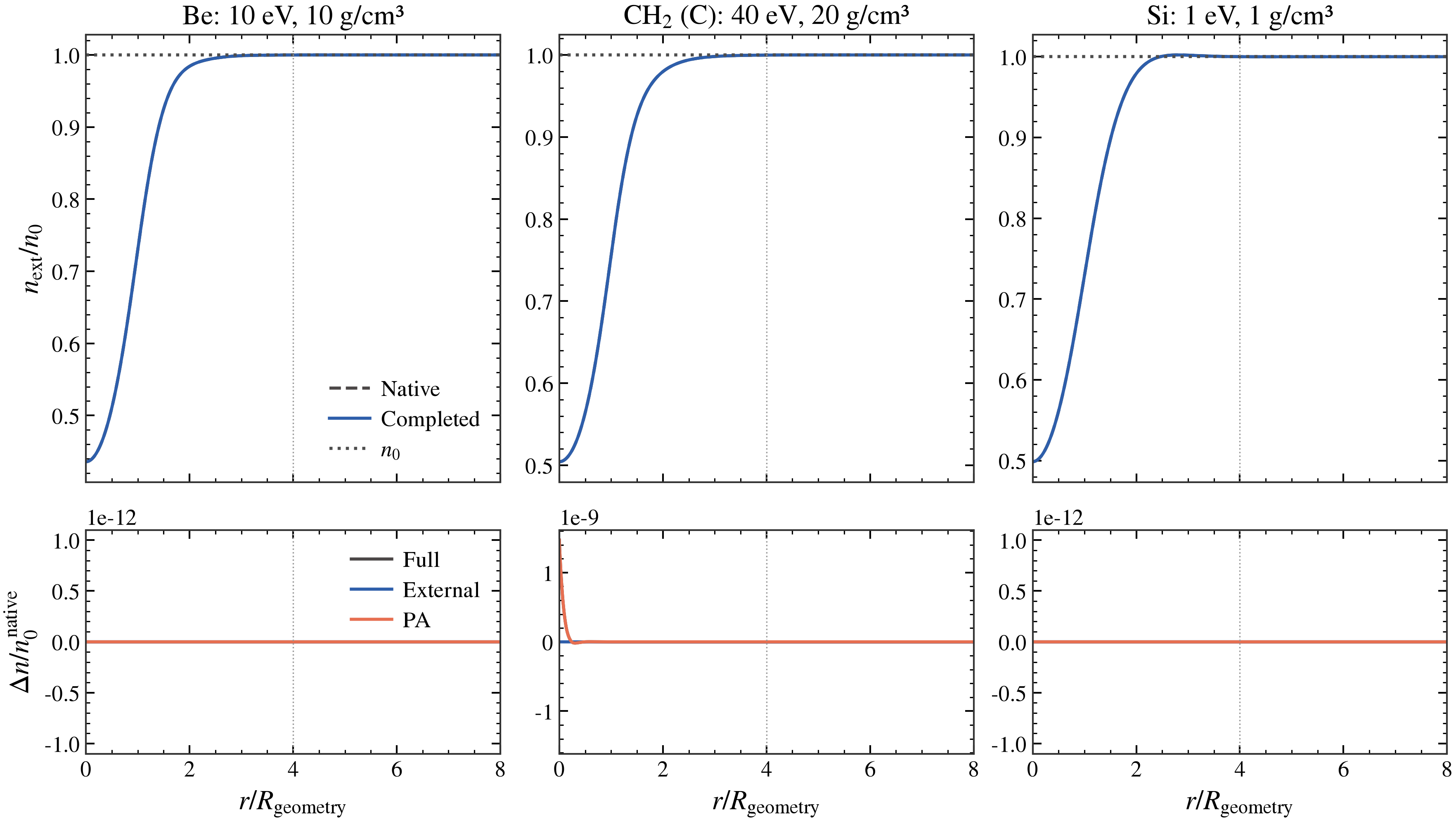
Upper panels show each calculation’s external density divided by its own
background \(n_0\), including the uniform reference explicitly.
Lower panels show signed density changes divided by the native
\(n_0\). The vertical dotted line marks the nominal B3 handoff.
PDF.
Interpretation
The analytic control verifies the free contribution and its implementation. Material comparisons test the complete coupled calculation at the listed conditions. Neither a small correction nor successful SCF stopping alone establishes source-charge convergence. Existing full/external/PA charge errors are retained in the table; no density rescaling is applied.
The correction preserves the number of propagated channels. These controls make no complete-workflow speedup claim and do not establish that B3 can be removed. See Benchmark data and provenance for the distinction between numerical and physical validation.
A small change in the final SCF profile is expected when the native angular sum is already accurate throughout the B3 fitting region. Restoring the outer free contribution does not by itself demonstrate that fewer interacting channels or a shorter propagation domain are sufficient.
Downloads: